
My Child Wants to Quit Jiu-Jitsu: A Father’s Perspective on the Hard Days
By Angel Ortiz · 7 min read
When a child wants to quit jiu-jitsu, I wouldn’t start with either “Then quit” or “You’re going whether you like it or not.” I’d start by trying to understand what feels difficult. A tired afternoon, an unfamiliar activity and an experience that feels unsafe call for different responses.
I’m Angel Ortiz, a father of two daughters who train at Radji Barrett Jiu-Jitsu Academy. I approach this as a father first, a practitioner second and a kids’ coach third. That order matters to me.
Her first day was not the whole story
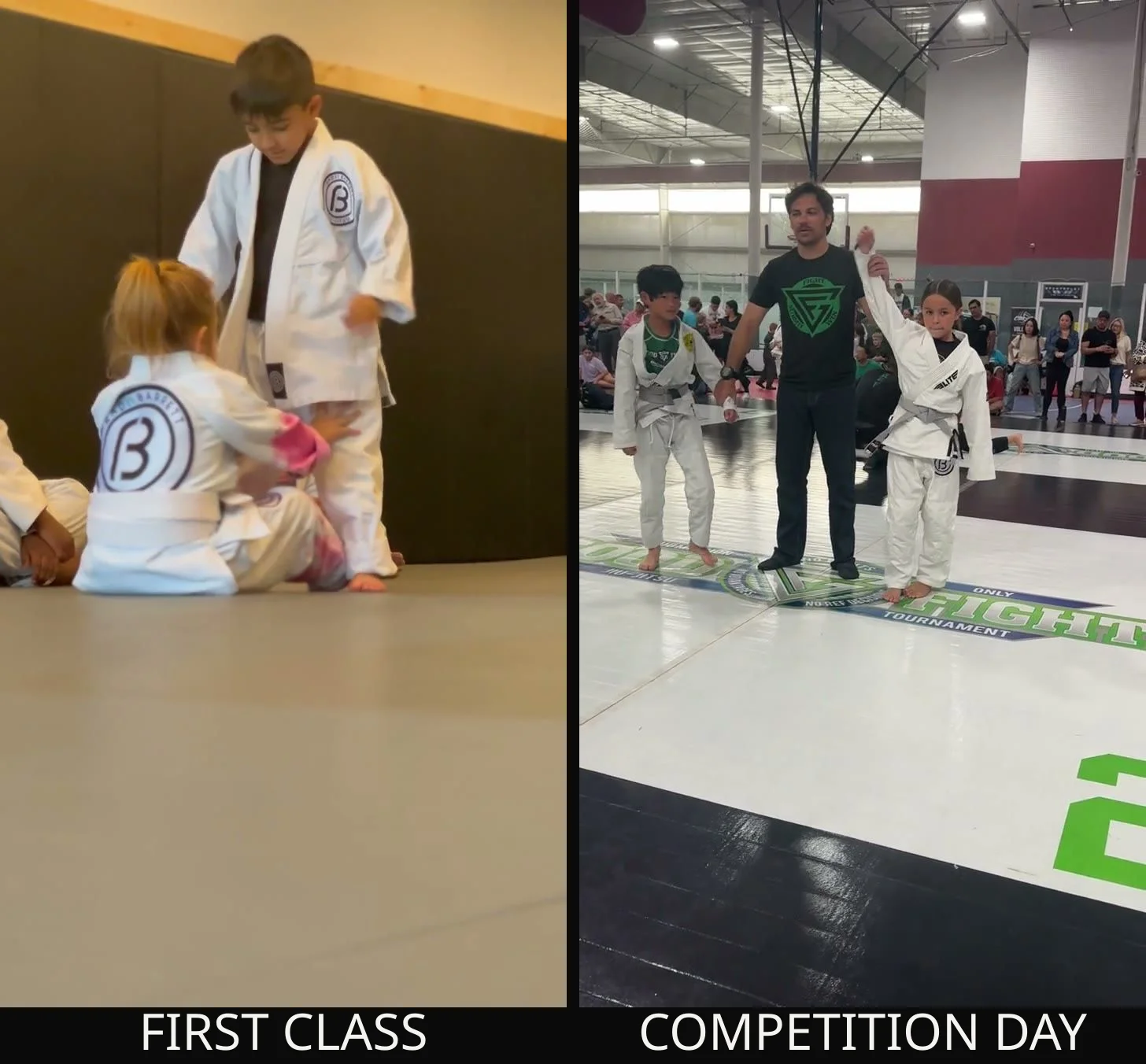
My youngest daughter was kicking, screaming and refusing to go inside on her first day. That was our beginning, not a child eagerly running onto the mats.
I brought her into class. Shivil and Shlok Sachdeva, the twin brothers and black belt instructors, were teaching. I knew them from my oldest daughter’s classes when the academy was in Edison. I knew the environment I was introducing her to, and I believed it was worth helping her try.
That was a decision about my child in a setting I knew. It is not a rule that a crying child should be made to train. Parents need to understand what is happening, and a child’s distress deserves attention.
I didn’t want one difficult moment to make the entire decision. Listening to a feeling and letting that feeling settle every decision are different things. My responsibility was to offer guidance while continuing to listen.
What mattered when her hand went up
Over time, she kept training. There were good days, frustrating days and plenty of repetition.
Eventually, I was coaching her from the sidelines at a competition. She listened and applied the guidance I was giving her. When her hand was raised, I could barely hold back my tears.
Winning was exciting. What moved me most was seeing her receive instruction under pressure and use it. I was thinking about the child who hadn’t wanted to enter that first class, and everything between those moments.
That is one family’s experience, not proof that persistence produces a victory. Competition is optional in our kids’ program. A child should not have to compete, or win, to have their effort valued.
There were days neither of us wanted to go
My daughter has had days when she didn’t want to train. So have I.
Sometimes I’m tired. Sometimes life is busy, and training feels like one more thing. Being a practitioner helps me remember that reluctance isn’t something only children experience.
Brian Tracy writes about self-discipline as following through without waiting until you feel motivated. I find that useful when thinking about my own commitments. It isn’t a test for deciding whether a child’s distress should be ignored.
Some days we least wanted to attend became days we were grateful we showed up. Sometimes there was a promotion; other times, a worthwhile lesson. Not every difficult day ends with a reward. We simply cannot always predict its value beforehand.
Discomfort is not the same as distress
Learning can involve mistakes, uncertainty and frustration. But discomfort itself is not the goal.
The Child Mind Institute’s guidance on encouraging children emphasizes manageable steps, the child’s interests and reassessing when pressure causes significant distress. It is general parenting guidance, not evidence that jiu-jitsu treats anxiety.
I would think differently about a child struggling with a movement than one reporting pain, rough treatment or fear of a particular person. Repeated dread, emotional overload or a sudden change in behavior deserves investigation, not a speech about toughness.
You cannot always tell what is wrong from behavior alone. Talk when things are calmer. If anxiety persists or gets worse, the American Academy of Pediatrics recommends talking with the child’s doctor. Injury, bullying or unsafe instruction should be addressed before asking a child to continue.
Coachability is not blind obedience
Coachability, to me, means being willing to learn, ask questions, accept constructive correction and try a useful adjustment. It does not mean ignoring pain, keeping quiet about unsafe contact or pleasing a coach at any cost.
In my daughter’s match, listening mattered because she could use the guidance, not simply because she followed an instruction.
That is what I hope children can practice: treating a correction as information rather than a judgment of who they are. They need patience and room to make mistakes. Whether that carries into other parts of life will differ from child to child.
Some days, learning looks different
I help coach within Professor Radji Barrett’s method and structure. Fatherhood shapes how I pay attention to the children in front of me.
A child arrives with more than their last training session. School, friendships, screens, family circumstances or something they cannot yet explain may be on their mind. I should not assume which, if any, is affecting them.
I consider whether the next step could be watching a demonstration, trying a basic movement, hearing a simpler explanation or talking with a parent. Sometimes the child needs rest. These are possibilities to discuss, not a promise that every class can be adjusted in the same way.
There is a familiar jiu-jitsu expression: sometimes you’re the hammer, sometimes you’re the nail. I take that to mean some days go your way and others don’t, not that being hurt or humiliated is part of learning.
What I’d do on a hard day
I’d choose a calmer moment to ask what happened, rather than begin by arguing about attendance.
For example, a parent might respond to “I’m not good at this” with “What part felt hardest today?” Or ask whether not wanting to go is about something in class or a difficult day. The answer matters more than getting through a prepared speech.
Then I’d speak with the coach. A manageable next step and a time to check in can be more useful than deciding everything at once. That might mean revisiting expectations, discussing participation or taking a break. Stopping an activity can also be the right decision.
Parents and caregivers know their children in ways coaches don’t. Coaches may see things on the mats that are less visible at home. Neither perspective replaces the other.
Beyond one competition
In a conversation on The Pete and Sebastian Show, Dana White says, “Put your kids into Jiu-Jitsu,” and talks about carrying a skill beyond a season of sport. That is his opinion, not a guarantee about what a child will gain or an endorsement of our academy. What resonates with me is the longer view: a competition can be meaningful without becoming the whole reason a child trains.
Notice progress before anyone raises a hand
Belts and results are easy to notice. Asking for help, encouraging a newer partner or trying again after a mistake can be quieter signs of learning. Those are examples of progress to look for, not transformations I can promise.
Two children can begin together and develop differently. I don’t want a comparison with another student to hide the effort a child is making.
Our academy is now at 540 New Brunswick Ave, Fords, within Woodbridge Township in Middlesex County, not the Edison location where our family’s story began. For practical first-visit information, see our parent’s first-class guide; for an uncertain newcomer, see our guide to starting with a shy or nervous child. I’ve also shared how our family first chose jiu-jitsu.
If you’re already part of RBJJ, please tell us when your child is having a hard time. If you’re considering a class, a free kids’ trial can be a way to learn about the environment without arriving with a final decision.
My daughter’s raised hand is a moment I treasure. But the part I value most happened between that moment and the first day she didn’t want to enter.
We’re not simply interested in seeing how good at Jiu-Jitsu your child can become. We’re interested in seeing who they can become through Jiu-Jitsu.